


A side return gate is the quietest piece of fencing you own. It sits between the house and the boundary, hides the bins, and gives you a shortcut to the back garden. It also gives anyone else a shortcut, usually out of sight of the street and of your neighbours' windows. Hidden and unglamorous is exactly why side gates are so often the softest point on an otherwise sensible property.
The good news is that they rarely fail because of anything clever. They fail for ordinary reasons: hinges that lift off, a latch screwed into soft timber, a frame that has started to rot, a bottom panel that gives way to a boot. Fix those and the gate stays genuinely usable — which matters, because a gate that is awkward to open is a gate that gets wedged open with a brick.
Start With the Hinges: Stop the Gate Lifting Off
Open the gate, then try to lift it straight up off its hinges. If it comes free, or nearly does, you have found the problem. Traditional hook-and-band hinges, and plain butt hinges on a removable pin, can be lifted away in seconds even when the gate is locked. The lock never gets touched.
Two fixes, often used together:
- Hinge bolts (sometimes sold as security hinge bolts) fit into the hanging stile and shoot into the post when the gate closes. Even if the hinge pins are cut, the hinge side stays put.
- Bolt-through hinges with dome-headed coach bolts, so the fixing cannot be unscrewed from the outside. Ordinary screws on the outer face mean anyone can take the gate off with a screwdriver.
On a metal gate, welded hinges are good, but only if the top of the hook is capped or the pin is fixed. A welder can run a bead across the top in a minute or two.
Locks, Bolts and Lock Guards
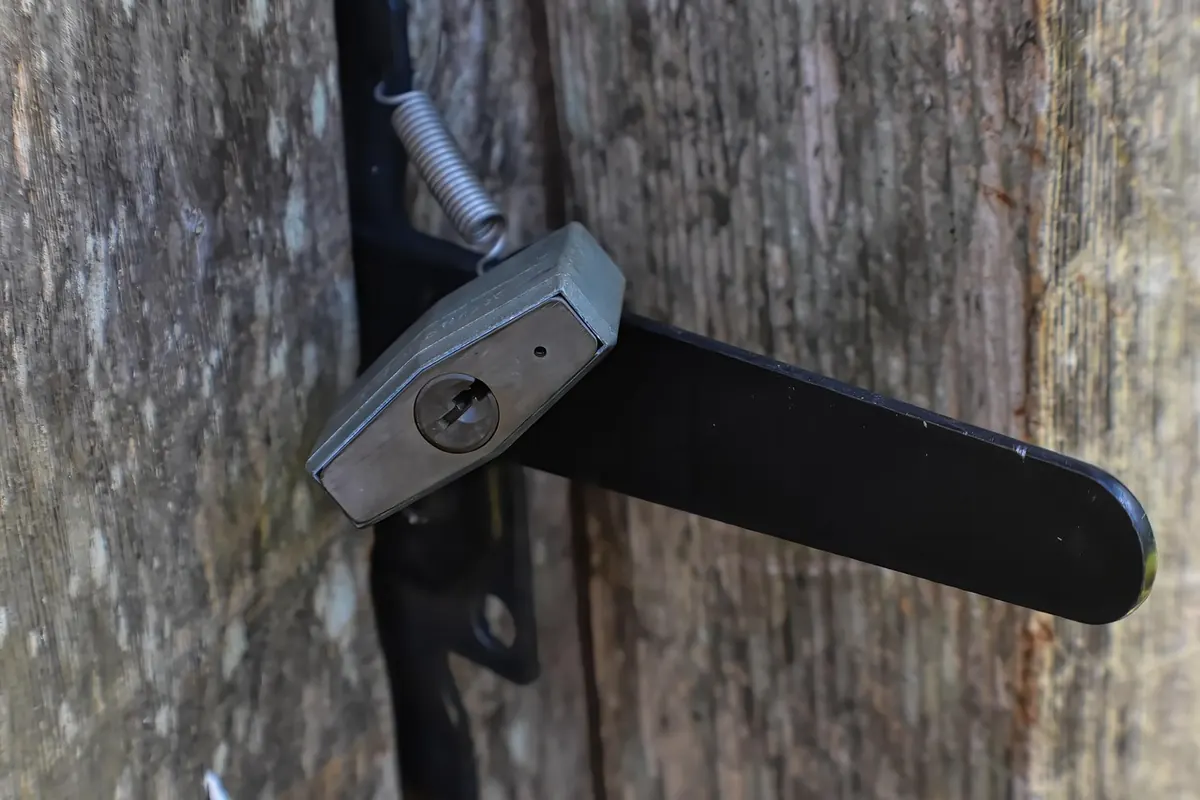
A latch holds a gate shut. A lock keeps it shut. Those are different jobs, and plenty of side gates only have the first one. Fit a key-operated deadlock, or a hasp and closed-shackle padlock designed for outdoor use, and add a lock guard so the shackle cannot be reached with cutters.
Spread the load, too. A single lock at mid-height can be forced by pushing against the top or bottom corner of a flexible gate. Pair it with a shoot bolt at the top and another at the bottom, so the gate is held at three points. That is the difference between a gate that rattles and yields and one that simply does not move.
A few details worth getting right:
- Keep the gap between gate and post slim — if a lever or crowbar fits in, it will get used.
- Use coach bolts or security screws for the lock and hasp, not short screws into end grain.
- Have locks keyed alike so one key opens the side gate, the shed and the back door. It stops people leaving the gate unlocked "just for now".
- Keep a spare key somewhere sensible, or fit a coded key safe inside the boundary where it cannot be seen from the street.
If your insurance policy lists requirements for external doors and gates, check what it says before you buy. A quick call to your insurer settles it.
Kick Plates, Braces and a Frame Worth Locking
Most side gates are timber, and most of them flex. A gate that twists can be prised open at the lock even when the lock itself is decent, so a diagonal brace or a vertical stiffener running between the bottom and top rails is money well spent.
Then there is the bottom panel. Kicking through the lower boards is crude but effective, and it happens more often than people expect. A kick plate — a strip of aluminium or galvanised steel screwed across the bottom of the gate — protects the most abused part of the timber. A second plate on the closing stile, where a hand or bar might work the wood, is worth considering too.
Finally, look at the post. A gate is only as solid as what it hangs on. A post that has rotted at ground level makes every other upgrade pointless, and no lock compensates for a hinge pulling out of soft wood. If the post moves when you lean on it, that is your first job.
Visibility Without Giving Up Privacy
You do not have to choose between a solid gate and a see-through one. The aim is to remove the cover an intruder relies on, while keeping the alley private at eye level:
- Replace the top two or three boards with slatted trellis, a metal railing section or a short run of vertical bars.
- Set a small panel of clear or frosted polycarbonate into the upper part of the gate.
- Trim the planting along the alley so the gate is visible from the house and from a neighbouring window. Prickly shrubs near the boundary are useful; overgrown ones against the gate are not.
- Fit a PIR light covering the approach to the gate, not just the inside of your garden. Light that comes on as someone arrives is more useful than a lamp they can reach.
A camera aimed at the gate from the house adds a layer, but if it records beyond your boundary there are data protection rules to consider, so keep it pointed at your own property where you can.
Keeping the Gate Easy to Use
Security that gets in your way will be defeated by you. Aim for a gate that opens with one hand while the other holds a bin bag or a child's hand: a latch stiff enough not to rattle open but smooth enough to work from either side, a handle at a sensible height, and no bolt so tight that only one person in the house can shift it.
Self-closing hinges, or a spring and a gate stop, are worth fitting if children use the gate or if it tends to be left swinging. And keep the swing clear — bins, plant pots and coiled hose reels all turn a good gate into an obstacle.
A Sensible Order of Work
- Check for lift on the hinges and fit hinge bolts if needed.
- Inspect the post and frame; replace anything soft or loose.
- Fit a keyed lock and lock guard, plus shoot bolts top and bottom.
- Add a kick plate and a brace or stiffener.
- Improve sightlines and lighting around the gate.
- Test the whole thing from the outside, in the dark, one-handed.
- Re-check fixings and oil the lock once a year.
None of this turns a side gate into a fortress, and it does not need to. It needs to be more trouble than the gate next door, and awkward enough that anyone trying it makes noise, takes time and stays visible. That is usually enough.
Photo: Ray_Shrewsberry / Pixabay